
Open to contract and full-time remote roles
AI systems that
Search is splitting in two. Classic rankings still matter, but a growing share of buyers ask ChatGPT, Perplexity or Google's AI Overviews and act on the single answer they get back. I build the tooling that measures whether you are in that answer — then fix what it finds.
Every page scored for whether an AI engine can actually read, trust and quote it. Not a vague grade: a per-page list of what is missing and why it costs you.
Each finding carries the evidence behind it and the exact change to make, ranked so the work that moves the needle comes first.
If something couldn't be measured, it says so instead of scoring you zero. You never act on an invented number, and you always see what the score is based on.
Re-run it and get a before and after on the same pages. Claimed fixes are re-checked by a later run, not taken on trust.
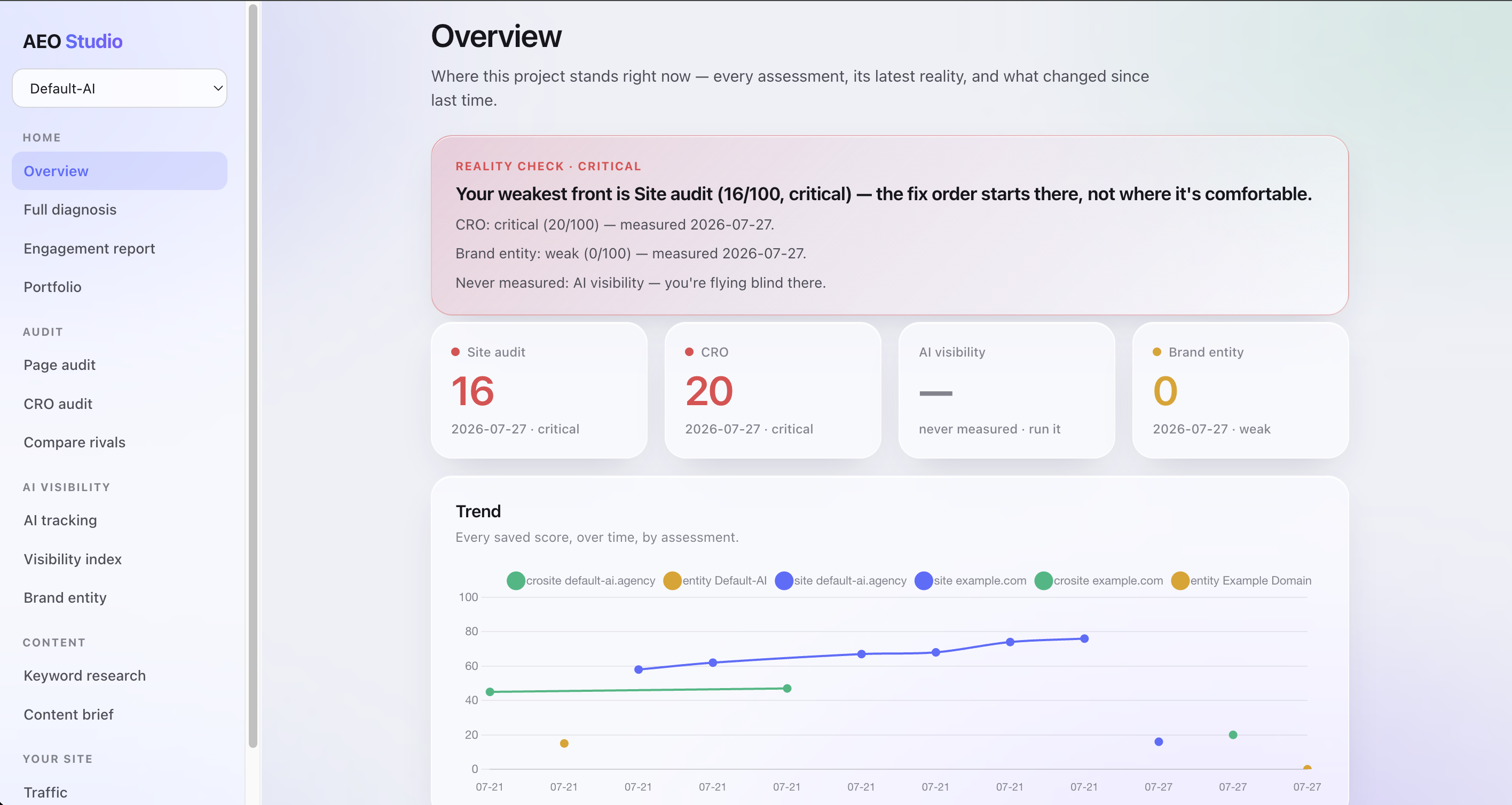
I built it myself. It reads a site the way an answer engine does — structured data, entity strength, crawlability, content worth quoting, and the conversion path that has to survive the click — across six answer engines. It reports what it could not measure as plainly as what it could.
AEO is where search is going; local is where service businesses still earn their living. I have built both. Across the 70+ sites I shipped, local was standard: a service × city page architecture, local keyword targeting, and Google Business Profile set up alongside. Four of those builds, live today:
Roughly 500 service-area landing pages across four clients. These were build-and-handover engagements, so I hold the architecture and the implementation, not ranking reports — and I would rather say that than imply otherwise.
These are sites I built and handed over — not accounts I maintain. Nobody has touched their SEO since. They are scored today, against 2026 AI-citation criteria that did not exist when they were built, by a stricter tool than the on-page audit score on my résumé. That gap is the point: the job is knowing which of these gaps is worth an hour and which one this brand will never win.
I build AI automation systems that solve real business bottlenecks. Voice agents that answer calls and book appointments. Meeting intelligence that turns conversations into tracked, source-cited action items. Workflow automation that removes the manual work, and the technical SEO and answer-engine tooling that gets those businesses found.
Eight systems, built end to end. Two of them you can try live, right here on this page.
Three agents on one voice and telephony stack: a receptionist that answers calls and books appointments around the clock, an outbound setter, and a Shopify support agent that reads real order and tracking data.
Turns every meeting into tracked, source-cited action items and topics, with zero hours of manual organization.
Measured over the first production run. Manual sorting went from two to four hours a day to zero.
Scores pages for citation in AI answers: structured data, entity strength, crawlability, and share of voice, each finding with a specific fix.
Multi-tenant accounts-payable and receivable automation that reads invoices, matches them, and routes approvals to a human in Slack.
Built and tested end to end across nine workflows, not yet switched on with live credentials. There is no payment step by design, so the worst case is a wrong draft sitting in an approval queue rather than money leaving an account.
Watches roughly 35 public procurement sources for work in one firm's exact trade lines, then qualifies every item against their real scope and explains the verdict. It also finds the suppliers, the repeat buyers, and the people who write the specs before a job is ever posted.
In daily use at a specialty-construction firm under NDA, so the client is not named and there is no public demo.
Generates lesson plans for Philippine teachers that stay compliant with the government curriculum, grounded in the official guidelines rather than the model's own memory.
Currently in build, not yet released. Listed here for completeness rather than as a shipped product.
70+ production sites across Webflow, Shopify (Liquid), and Wix (Velo), for US small businesses in 12+ industries.
Real before-and-after results on live client sites: on-page technical health and organic growth.
On-page audit scores, and about 85% average across 70+ sites. Now focused on answer-engine optimization: getting businesses cited inside AI answers, not just ranked in classic search.
In August 2026 I pointed my own engine at 11 of these sites — none maintained since handover — and scored them for AI-citation readiness. First-party data, homepage of each site.
Median citation-readiness across the eleven. The range ran 22 to 68 — not one of them close to what an answer engine wants.
Score under 50 on the AEO signals specifically: no answer-first opening, no quotable structure, nothing an engine can lift cleanly.
Carry no entity signal at all — nothing on the wider web an AI can use to verify the business is who it says it is.
Serve under 220 words of raw HTML. A crawler that doesn't run JavaScript opens them and sees an empty page. Both look perfectly fine to a person.
These are two different scales, and the gap between them is the point. The 85% above measures on-page technical health at handover. The 50 measures whether an answer engine can read, trust and quote the page today — against criteria that did not exist when these sites were built. Closing that gap is the work.
A short history. Tap any role to open it.
Stack: TypeScript/Node, Next.js, Postgres/Supabase, n8n, Claude API. Deployed on Vercel and Railway, built with Claude Code.
Open to contract and full-time remote roles, and to project work. Tell me the bottleneck and I'll tell you how I would automate it.